
Overview
Every March and October, RNID runs Free Wills Month where supporters can write a free Will through one of two delivery partners, Octopus Legacy or the National Free Wills Network (NFWN). The offer had never worked for BSL supporters as it had no structured way to say “I need an interpreter” and no backend logic to which partner is best suited to their needs, and every enquiry was manually reviewed and arranged by just one member of staff.
My focus was the interaction element that could fix this complex flow which was a short, branching triage flow that takes a supporter’s answers about how they want to make their Will and whether they need a BSL interpreter, resolving them automatically to the right partner, with the correct contact method, and a confirmation screen written for their specific situation.
The problem
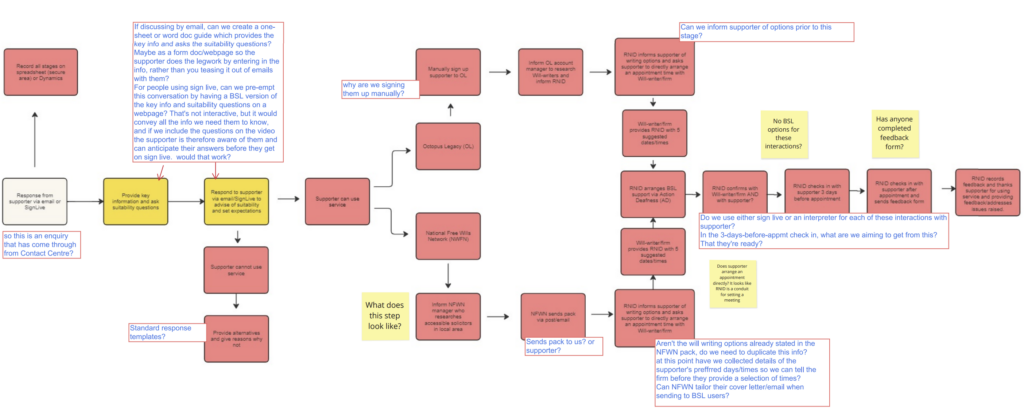
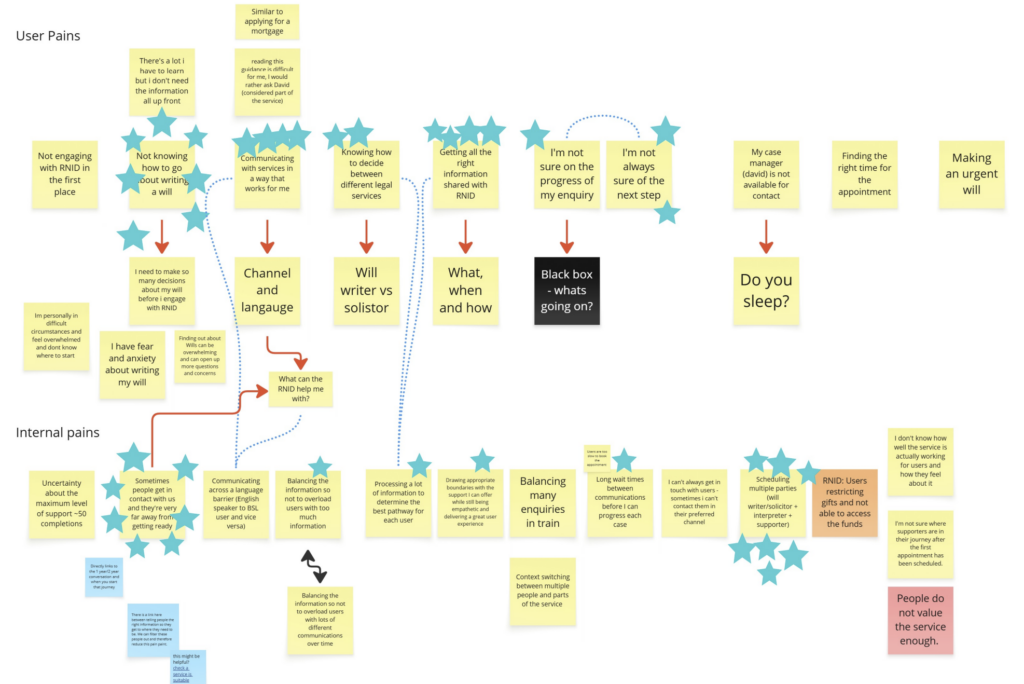
RNID’s free Will writing offer worked reasonably well for hearing supporters but broke down at almost every stage for BSL users due to:
- No way to flag an interpreter need early in the journey.
- No suitability screening at the contact centre if this was their happy path.
- RNID’s SignLive interpreting application wasn’t set up for outgoing calls which meant BSL users couldn’t even be called back in their own language.
Every enquiry was matched to a delivery partner by hand, by one person, over email which just wasn’t sustainable anymore and not an efficient way of working.
Outcome in brief
The team removed the manual triage for 6 of the 8 supporter paths, a journey that used to depend on one coordinator reading every email is now resolved automatically.
We also saw an increase in engagement after the service was launched, alongside signs of more BSL supporters choosing to leave a gift in their Will to RNID which saw a 5% increase from the previous year.
We piloted the service successfully within March’s Free Wills Month, with a feedback mechanism built into the journeys to keep improving the logic post launch.
Discovery
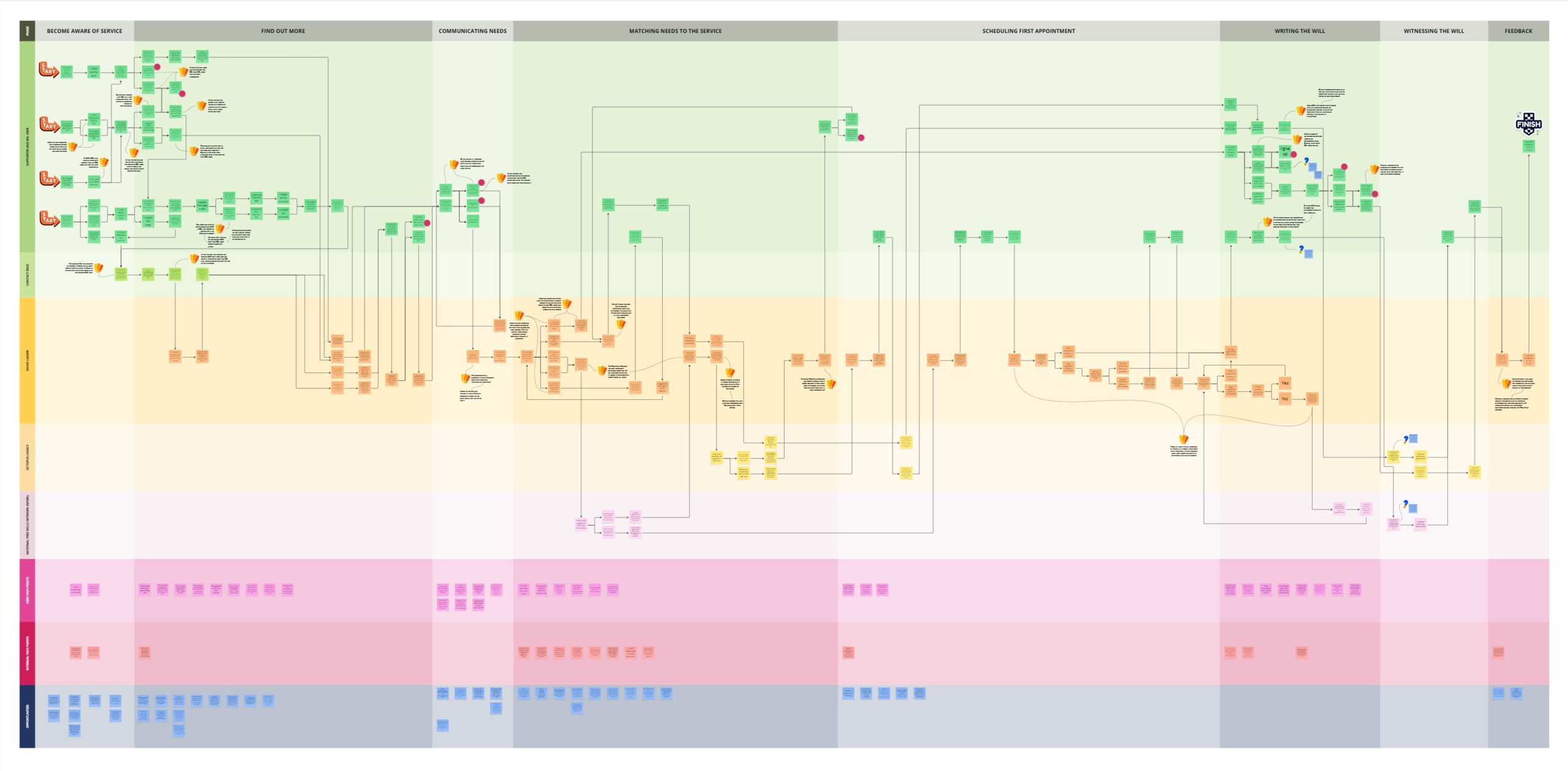
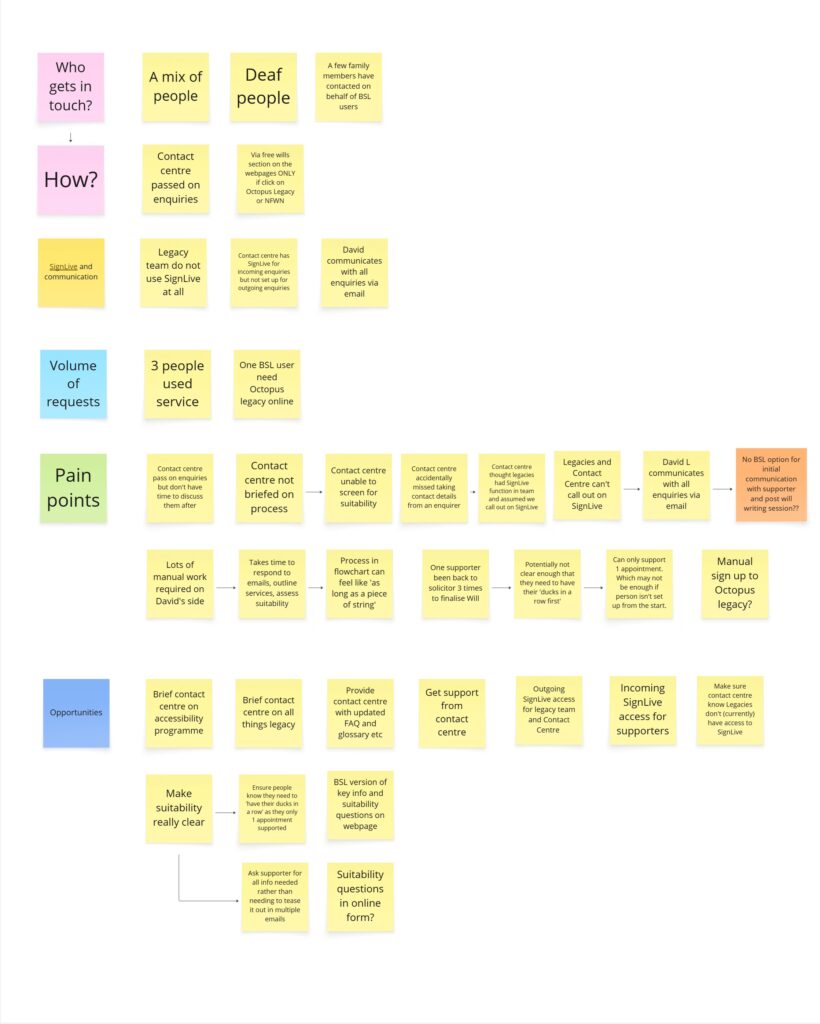
RNID had invited a design team from Nationwide (part of their volunteering days) to a two-day workshop which saw us map the existing process end-to-end, stage by stage, rather than relying on how anyone assumed it worked.
Reframing three priorities
Workshop findings were distilled into three “How Might We” opportunity areas, ranked by priority, to focus the design phase.

Priority 1 became the core structure of the design work as this reframed the brief from “improve the Wills pages” to a sharper, more specific interaction design problem of ‘how might we get someone to the right service without a human having to read their enquiry first?’
Design
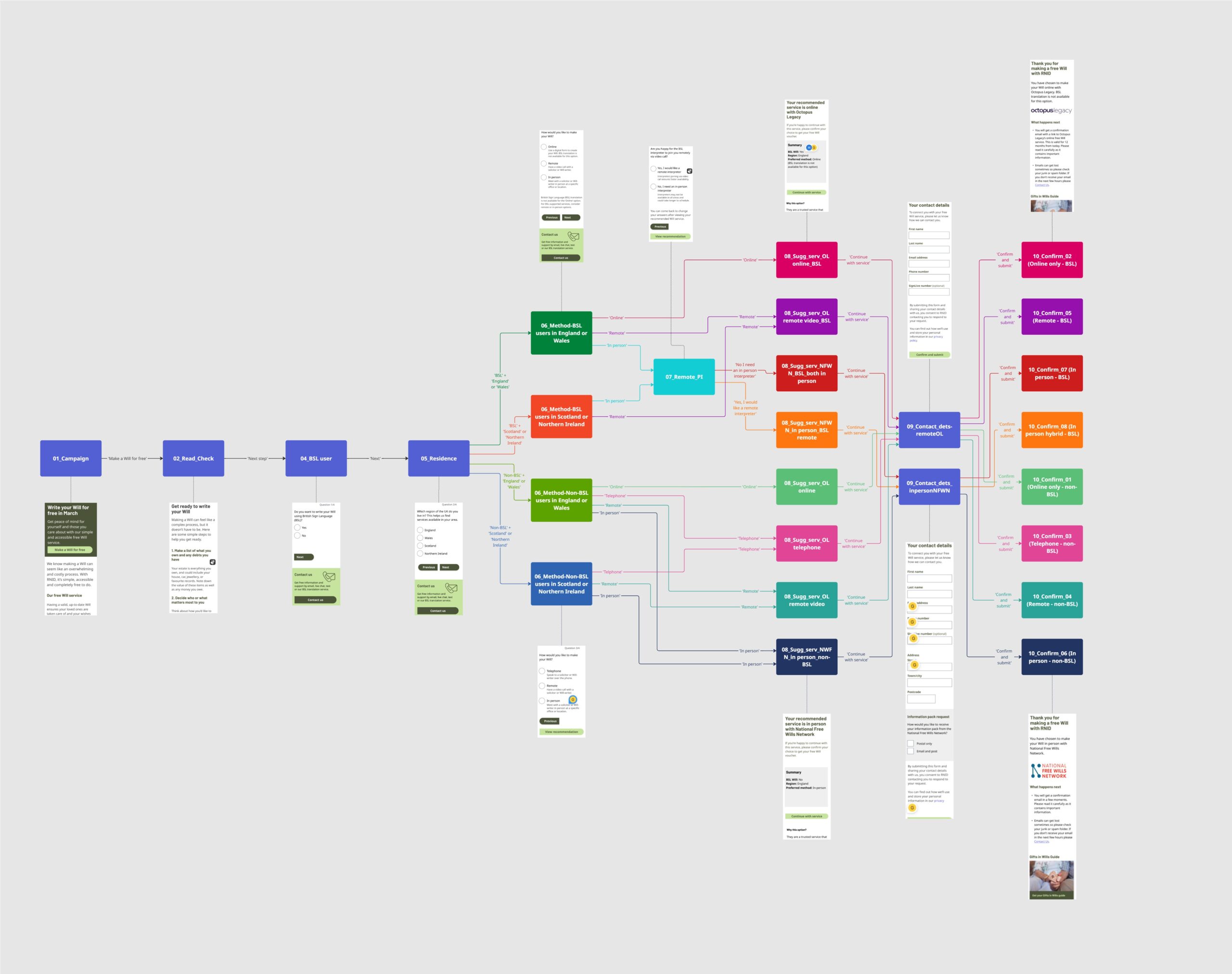
Before any screens were built, the multiple routes had to be defined precisely enough to work as a proper flow. We decided that four questions would be enough to determine the outcome:
- Do you use BSL?
- Where do you live?
- How do you want to make your Will?
- Do you need an interpreter?
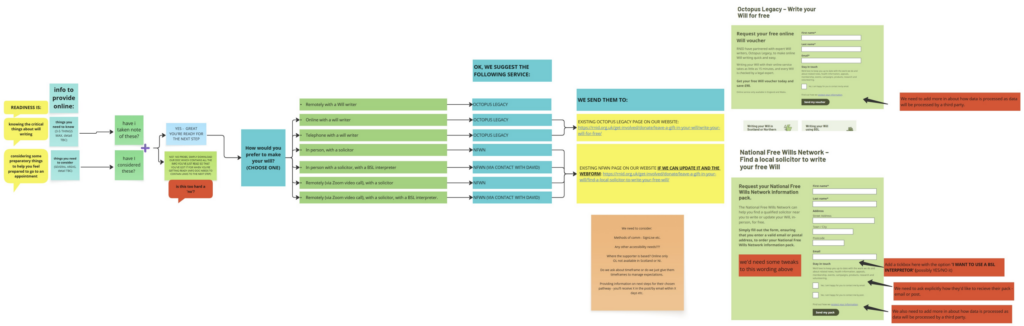
It was a deliberate design call to automate what’s routine, and only pull a person in at the one point of ‘booking an interpreter’ as this was the step that was a bit more complex due to appointments and scheduling.
The table below is how that logic reads once translated into the final build
| BSL user? | Method | Interpreter? | Partner | Confirm screen |
| No | Online | No | Octopus Legacy | Online only non-BSL |
| No | Telephone | No | Octopus Legacy | Telephone non-BSL |
| No | Remote (video) | No | Octopus Legacy | Remote non-BSL |
| No | In person | No | NFWN | In person non-BSL |
| Yes | Online | Yes | Octopus Legacy | Online only BSL |
| Yes | Remote (video) | Yes | Octopus Legacy | Remote BSL |
| Yes | In person | Yes | NFWN, via RNID coordinator | In person BSL |
| Yes | In person | Partially / hybrid | NFWN, via RNID coordinator | In person hybrid |
Getting this table right mattered more than any visual design decision as every screen, confirmation message, and piece of follow-up content exists to serve one row of it.

Prototyping
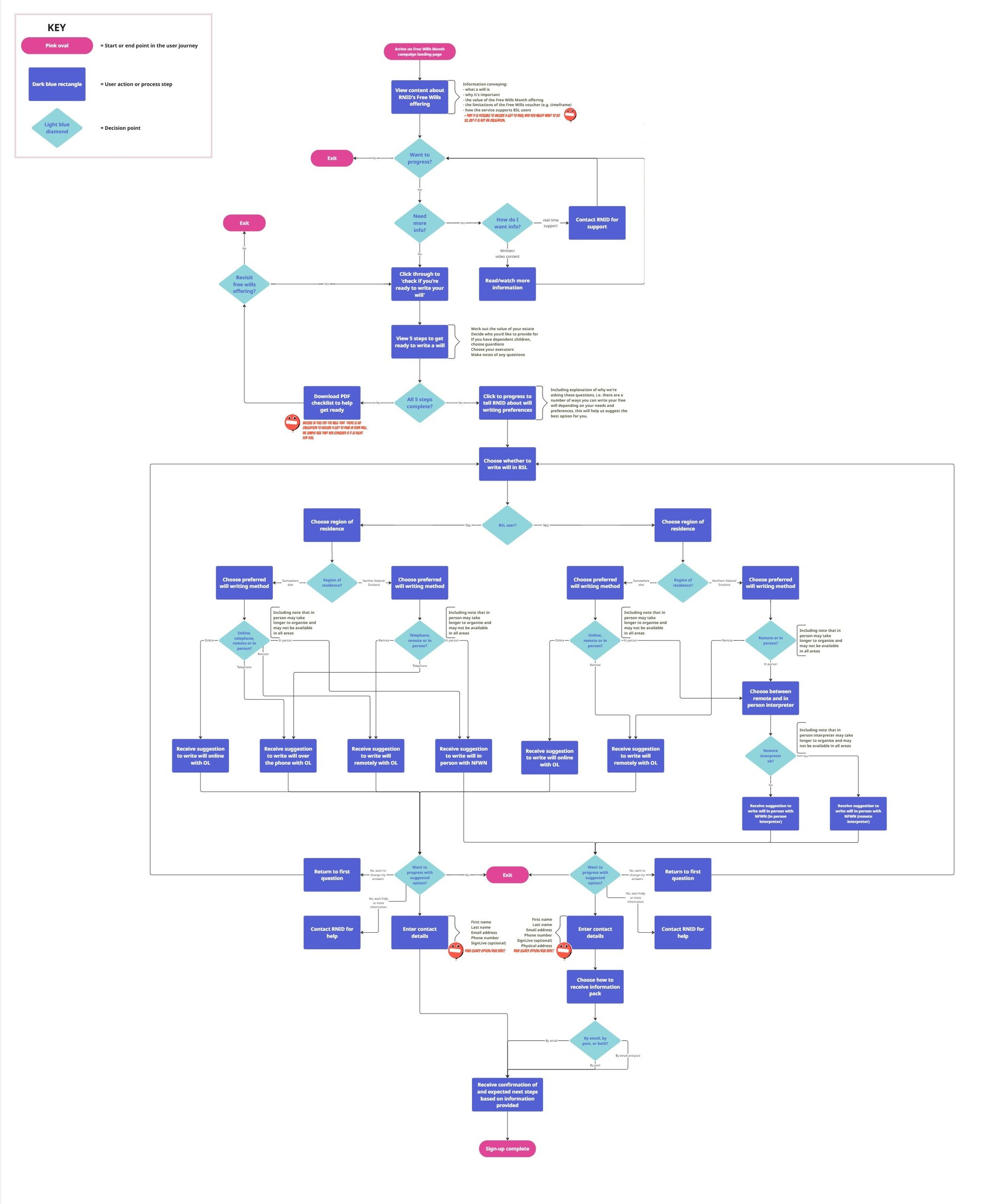
I took the eight flows from the simplified routes into high-fidelity screens built in Figma. It took three iterations, each improving an element, and the final pass was tested directly with BSL users before handover to development.
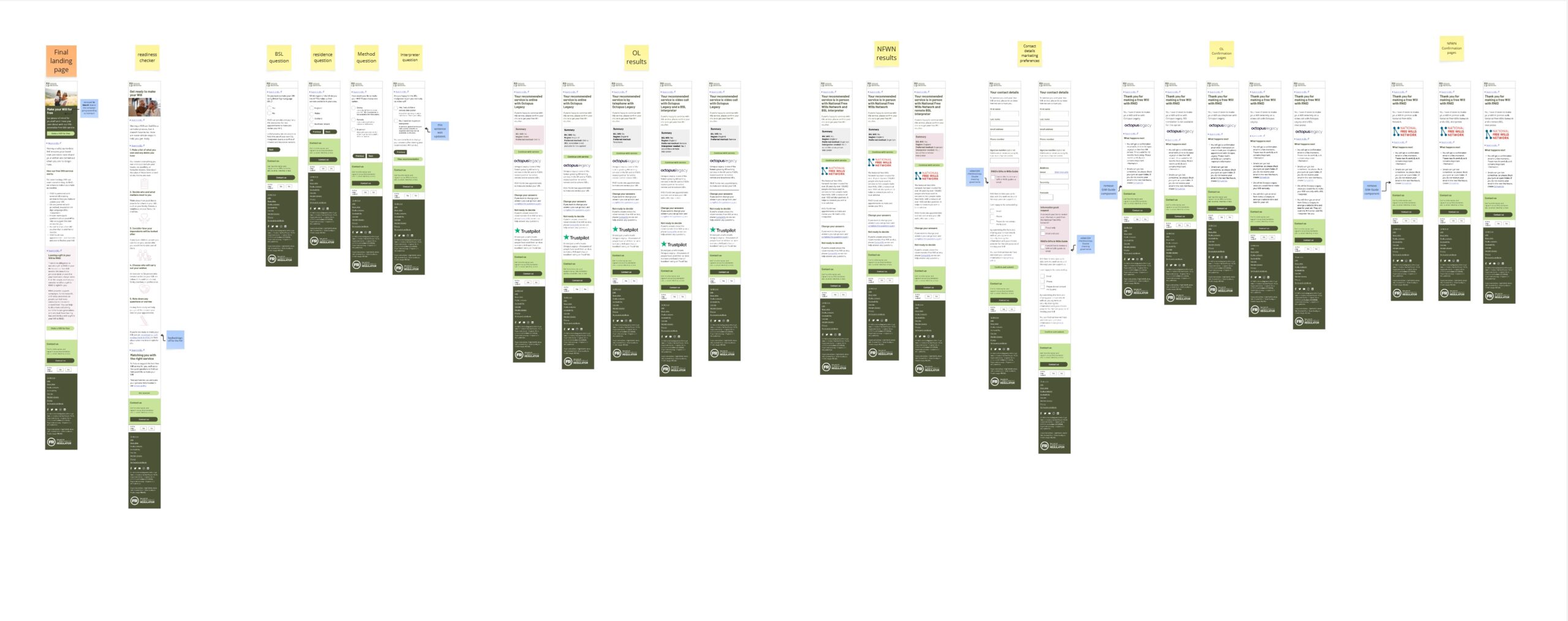
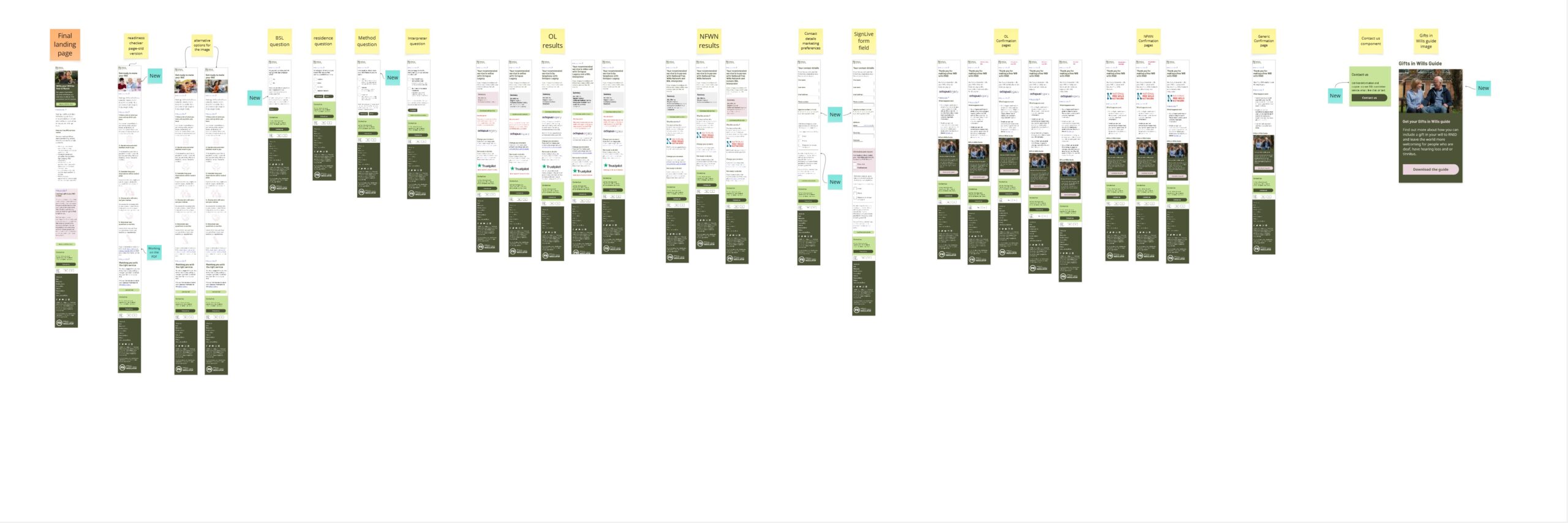
Final flow
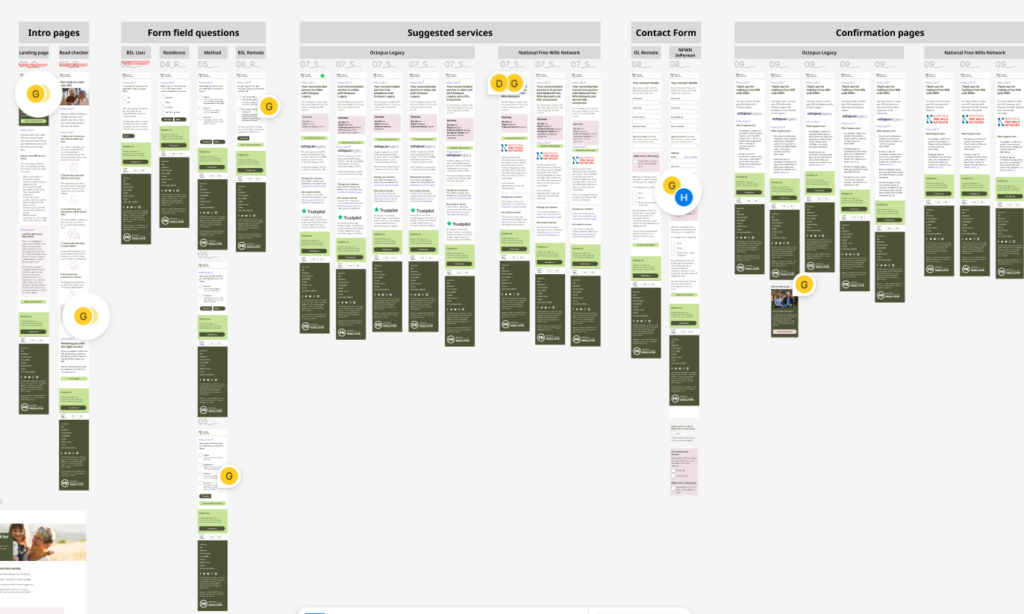
The final version numbers ten screens across four decision points, resolving to one of eight confirmation states.
Outcomes
The MVP was deployed within the deadline of March Free Wills Month, with feedback loop integrated:
- Manual triage removed for the majority of paths: Six of the eight outcome combinations now resolve without the coordinator reading or routing an enquiry by hand with the two interpreter booking paths still routing to a person by design.
- Irrelevant questions removed: Embedding interpreter needs inside the BSL branches meant hearing supporters and the majority of traffic never see a question that doesn’t apply to them.
- Customised confirmation pages: Eight bespoke confirmation states replaced what was previously a single email thread per enquiry.
- Edge cases caught before build: Found while wireframing every branch rather than only the happy path, and fed back into the decision logic before development started.
- Engagement increased after launch: The service has seen a rise in engagement, and early signs point to more BSL supporters choosing to leave a gift in their Will to RNID alongside a 5% increase.

Learnings
What went well
I created the user flows before touching a single screen, and I would do that again on any triage project. It kept every conversation with RNID, the delivery partners and the developers anchored to the same eight-row table of outcomes, rather than opinions about layout or requests to add more pathways.
Wireframing all eight outcomes, not just the happy path, caught two edge cases while they were still easy to fix. I also built the flow out in Figma and tested it directly with BSL users before handover to development, iterating the prototype on what I learned rather than relying on internal stakeholder review alone. Since launch, engagement has increased and more BSL supporters have chosen to leave a gift in their Will to RNID. That’s a positive sign that removing friction at triage mattered beyond just making the flow nicer to use.
What was difficult
Two of the eight paths couldn’t be automated, because interpreter booking genuinely needed a person’s judgement and we couldn’t access the partners’ systems. So designing a flow that’s mostly self-serve but hands off to a human at one point, without that handoff feeling like a dead end, took more iteration than I expected.
What I would do differently
I’d push for success measures and a benchmark to be agreed before launch, not after, so I could say with more confidence how much of the engagement and gift in Will increase was down to the redesign specifically. I’d also want more time between BSL user testing and the Free Wills Month deadline as the turnaround from testing to iterating to build was tighter than I’d have liked.